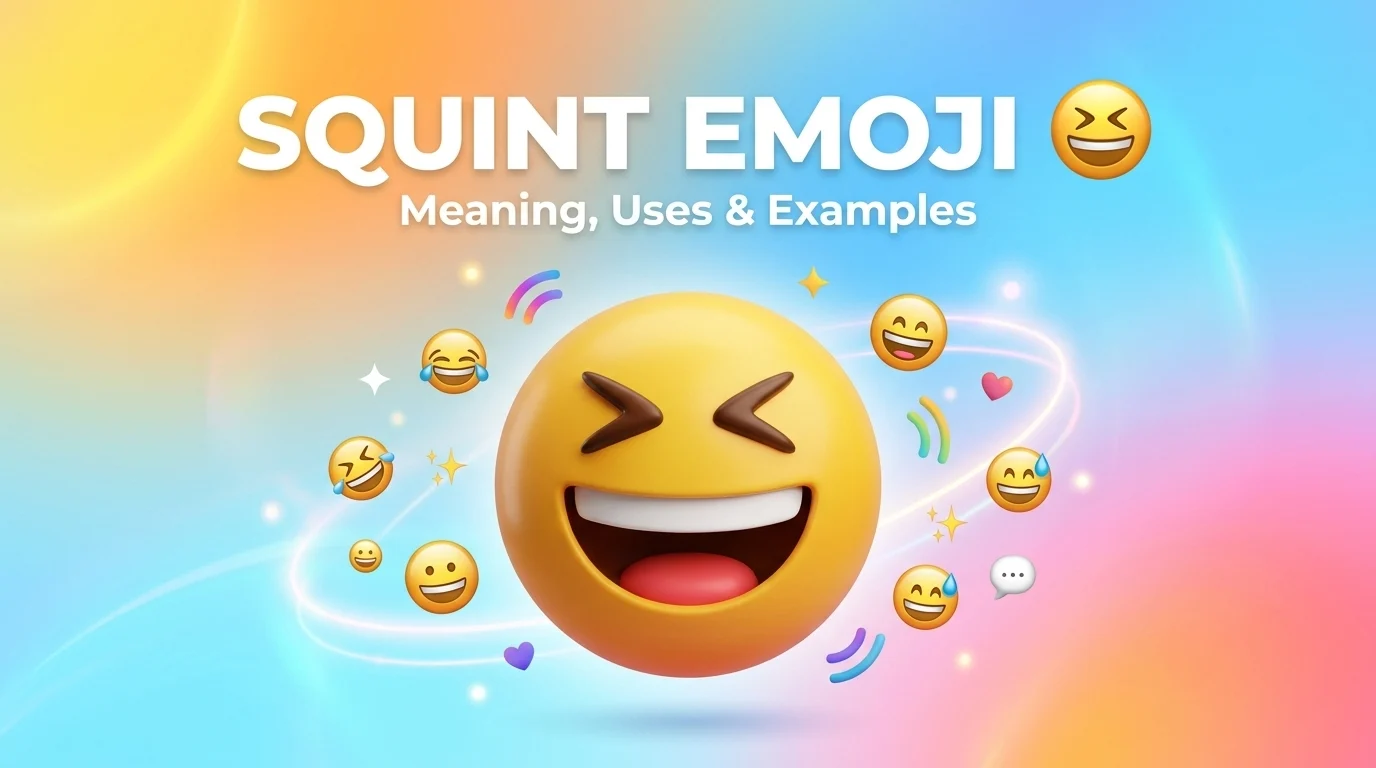
The squint emoji 😆 is one of those expressive emojis that can make a text message feel much more emotional and playful. Its tightly closed eyes and wide, open-mouth smile usually show strong laughter, excitement, or amusement.
People often use the squint emoji when something is genuinely funny, when they are laughing hard, or when they want to make a casual conversation feel more energetic. However, the exact meaning can change depending on the message, relationship, and situation.
In this guide, you will learn what the squint emoji means, when to use it, what it communicates, how it compares with similar laughing emojis, and how to copy and use it in everyday conversations.
Quick Answer: What Does the Squint Emoji 😆 Mean?
The squint emoji 😆 usually means laughing hard, strong amusement, excitement, or a playful reaction.
The closed, squeezed eyes make the expression look stronger than a normal smile. Therefore, people often use 😆 when something makes them laugh out loud or when they want to show enthusiastic amusement.
For example:
- “That video was hilarious 😆”
- “You actually said that? 😆”
- “I can’t stop laughing 😆”
- “We really thought that would work 😆”
Depending on the context, 😆 can also communicate playful embarrassment, excitement, or a joking reaction.
What Is the Squint Emoji 😆?
The squint emoji is commonly represented by 😆, officially known as Grinning Squinting Face.
It shows a broad smile with an open mouth and tightly closed, squinting eyes. The facial expression suggests that the person is experiencing a strong positive emotion.
Unlike a simple smiling emoji, 😆 looks much more energetic. It tells the reader that the reaction is not merely a polite smile.
The emoji can work especially well in casual conversations because it quickly communicates emotion without requiring a long explanation.
Squint Emoji Meaning in Text Messages
In texting, 😆 most commonly means:
- “That is really funny.”
- “I’m laughing.”
- “I can’t believe that happened.”
- “That made me laugh so hard.”
- “You’re being hilarious.”
- “I’m excited about this.”
- “That’s funny in a playful way.”
For instance, imagine your friend sends you a ridiculous photo and says:
“Look what I found from our old school trip.”
You might answer:
“No way 😆”
Here, the emoji strengthens the reaction. You are not simply acknowledging the message; you are showing genuine amusement.
The meaning depends on the message
The same emoji can communicate slightly different emotions.
“That joke was amazing 😆”
This clearly shows laughter.
“You really forgot your keys again 😆”
This sounds playful and teasing.
“We finally finished the project 😆”
Here, it can express excitement and relief.
So, always consider the surrounding words instead of interpreting the emoji by itself.
Why Does 😆 Look Like Laughing?
The visual design explains much of its meaning.
The emoji combines three important facial features:
- A wide grin — shows happiness and amusement.
- An open mouth — makes the reaction more energetic.
- Tightly closed eyes — suggests intense laughter or excitement.
When people laugh genuinely, their eyes can naturally narrow or close. The 😆 design exaggerates that expression to make the emotion immediately recognizable.
As a result, the emoji usually feels more energetic than 😄.
Squint Emoji vs. Similar Laughing Emojis
Several emojis can communicate laughter, but they do not always create the same tone.
| Emoji | Common Meaning | Typical Tone |
|---|---|---|
| 😆 | Strong laughter or amusement | Energetic, playful |
| 😄 | Happy smile or cheerful laughter | Friendly, positive |
| 😂 | Laughing so hard that you cry | Very funny, dramatic |
| 🤣 | Extremely intense laughter | Hilarious, exaggerated |
| 😅 | Nervous or relieved laughter | Awkward, embarrassed |
| 😁 | Big cheerful grin | Happy, excited |
| 😊 | Warm, gentle happiness | Sweet, friendly |
| 😏 | Smirk or knowing expression | Teasing, confident |
The biggest difference is emotional intensity.
For example, 😆 can say “That’s really funny,” while 🤣 often suggests “That’s unbelievably hilarious.”
Meanwhile, 😅 can communicate laughter mixed with awkwardness or relief.
😆 vs. 😂: What Is the Difference?
This is one of the most common questions about the squint emoji.
Both 😆 and 😂 can express laughter, but they have different visual styles.
😆 focuses on a wide grin and tightly closed eyes. It feels energetic and playful.
😂 includes tears of joy, so it usually communicates stronger or more dramatic laughter.
Compare these:
“You wore two different shoes today 😆”
This sounds playful.
“I just watched that video again and I’m crying 😂”
This sounds like something was extremely funny.
Neither emoji is automatically stronger in every conversation. Your wording and context still determine the emotional intensity.
😆 vs. 🤣
The difference between 😆 and 🤣 also comes down to intensity and style.
The 😆 squint emoji often feels like a big laugh or enthusiastic grin.
The 🤣 rolling-on-the-floor-laughing emoji usually represents extreme laughter.
For example:
- “That was a good joke 😆”
- “That was the funniest thing I’ve ever seen 🤣”
You can think of 😆 as strong, playful laughter, while 🤣 often represents over-the-top laughter.
When Should You Use the Squint Emoji?
You can use 😆 in many casual situations.
1. When Something Is Funny
This is the most obvious use.
“Did you see what happened in the group chat? 😆”
The emoji shows that you found the situation funny.
2. When Teasing a Friend
😆 works well when you are joking with someone you know.
“You really thought you could beat me at that game 😆”
Here, the emoji makes the teasing feel more playful.
3. When Reacting to a Funny Story
Someone may tell you something embarrassing or unexpected.
“I walked into the wrong classroom and didn’t notice for five minutes 😆”
You can respond:
“That sounds exactly like something you would do 😆”
4. When Celebrating a Funny Situation
Sometimes a situation becomes funny because everything goes wrong.
“We planned everything perfectly and then forgot the tickets 😆”
The emoji communicates humorous frustration.
5. When Showing Excitement
Although laughter is its main meaning, 😆 can also show energetic happiness.
“We’re finally going on vacation next week 😆”
Here, the emoji communicates excitement rather than pure laughter.
When Should You Avoid 😆?
Although 😆 is friendly in casual conversations, it does not fit every situation.
Avoid it when someone is discussing something serious, painful, or sensitive unless you clearly understand that they are joking.
For example, if someone tells you they had a serious accident, replying:
“Oh no 😆”
could appear insensitive.
Instead, use a more appropriate response such as:
“Oh no, are you okay?”
You should also be careful when communicating professionally. A laughing emoji can sometimes make a serious business message look less professional.
For example, this may not be appropriate in a formal work email:
“The report is late again 😆”
Even if you intend to joke, the recipient may interpret it differently.
Squint Emoji in Social Media
The 😆 emoji appears frequently in casual social media conversations.
People use it in:
- Comments
- Captions
- Replies
- Group conversations
- Memes
- Reaction posts
- Short-form videos
- Gaming discussions
For example:
“This is exactly what happens every Monday 😆”
or:
“I wasn’t ready for that ending 😆”
Because emojis communicate emotion quickly, 😆 can help a short comment feel more expressive.
Squint Emoji in Friend Chats
Among friends, 😆 can make teasing and jokes feel less serious.
Suppose your friend says:
“I studied for five hours and still forgot everything.”
You could reply:
“Maybe studying isn’t your thing 😆”
The emoji signals that you are joking rather than seriously criticizing them.
However, your relationship matters. A joke that works with a close friend may sound rude when sent to someone you barely know.
Squint Emoji and Sarcasm
People sometimes use 😆 with sarcastic comments.
For example:
“Yeah, because waking up at 6 AM is definitely my favorite thing 😆”
Here, the emoji helps signal that the speaker does not literally mean what they said.
However, emojis cannot guarantee that everyone will understand sarcasm. If the message could be misunderstood, add clearer wording.
Squint Emoji Copy and Paste
If you simply want to copy the squint emoji, here it is:
😆
You can copy it and paste it into:
- TikTok
- Messenger
- Discord
- Text messages
- Comments
- Captions
You can also combine it with other emojis.
Examples:
- 😆😂
- 😆🤣
- 😂😆
- 😆❤️
- 😆🔥
- 😆🙈
- 😆👍
Use combinations naturally rather than adding too many emojis at once.
Examples of Squint Emoji in Real Conversations
Here are several practical examples.
Friend: “I just sent the message to the wrong person.”
You: “You did WHAT? 😆”
Friend: “I tried cooking without reading the recipe.”
You: “And how did that disaster go? 😆”
Friend: “We won the match!”
You: “Let’s gooo 😆🔥”
Friend: “I forgot my password again.”
You: “Not again 😆”
Friend: “That movie ending was completely unexpected.”
You: “I know 😆”
These examples show how the emoji can communicate laughter, excitement, teasing, and playful surprise.
Common Misunderstandings About 😆
It does not always mean “LOL”
Although 😆 often communicates laughter, it does not literally translate to one fixed phrase.
It can also express excitement, playful teasing, or amusement.
It is not the same as 😂
Both emojis represent laughter, but their visual expressions differ.
😆 has tightly closed eyes and a broad grin, while 😂 adds tears of joy.
It does not automatically mean sarcasm
Some people use 😆 sarcastically, but that depends entirely on context.
It is usually casual
The emoji works best in relaxed conversations. Therefore, think about the relationship and setting before using it.
Tips for Using the Squint Emoji Naturally
Follow these simple tips to make your emoji use feel natural:
Match the emotion.
Use 😆 when your message actually has a playful or humorous tone.
Consider your audience.
Friends and family usually understand casual emoji use better than formal contacts.
Do not overuse it.
One emoji can communicate enough emotion. You do not need to add 😆 after every sentence.
Read the conversation first.
If someone is talking about a serious issue, avoid turning the conversation into a joke.
Combine emojis carefully.
😆😂 can emphasize laughter, while 😆❤️ can add warmth.
Let your words carry the main meaning.
The emoji should support your message rather than replace it completely.
Frequently Asked Questions About the Squint Emoji
1. What does the squint emoji 😆 mean?
The squint emoji 😆 usually represents strong laughter, amusement, excitement, or playful happiness. Its tightly closed eyes and wide grin create an energetic laughing expression.
2. Is 😆 a laughing emoji?
Yes. People commonly use 😆 as a laughing emoji. It usually shows that something is funny or that the person is reacting with strong amusement.
3. What is the difference between 😆 and 😂?
😆 shows a broad grin with tightly closed eyes, while 😂 includes tears of joy. Therefore, 😂 often communicates more dramatic laughter, although both can mean something is very funny.
4. Can 😆 mean excitement?
Yes. Although laughter is its main use, people sometimes use 😆 to show energetic excitement or happiness.
For example:
“Tomorrow is the big day 😆”
5. Is the squint emoji good for flirting?
It can appear in playful or teasing conversations, but 😆 is not specifically a flirting emoji. Your words and the overall conversation determine whether the message feels romantic or simply friendly.
6. Can I use 😆 in professional messages?
You can, but you should consider the workplace and recipient. In formal communication, it is usually safer to keep your tone professional unless your workplace regularly uses emojis.
7. What does 😆 mean from a friend?
A friend sending 😆 usually means they are laughing, amused, teasing you, or reacting enthusiastically. The exact meaning depends on what they wrote before or after the emoji.
8. Can I copy and paste the squint emoji?
Yes. The squint emoji is 😆, and you can copy and paste it into most modern messaging apps, social networks, comments, and text fields.
Conclusion
The squint emoji 😆 is a cheerful and expressive way to show strong laughter, amusement, playful teasing, or energetic happiness. Its wide grin and tightly closed eyes make it especially useful when a simple smile does not feel expressive enough. In casual chats, social media comments, and conversations with friends, it can quickly communicate a lively reaction.
However, context always matters. Use 😆 when the conversation has a light or humorous tone, and choose a different emoji when someone is discussing something serious. Once you understand the difference between 😆, 😂, 🤣, 😅, and other expressive faces, you can use the squint emoji more naturally and confidently.

I am Willie Michael, an author passionate about language and clear communication. I enjoy exploring synonyms and helping readers discover better, more precise words for everyday writing.